
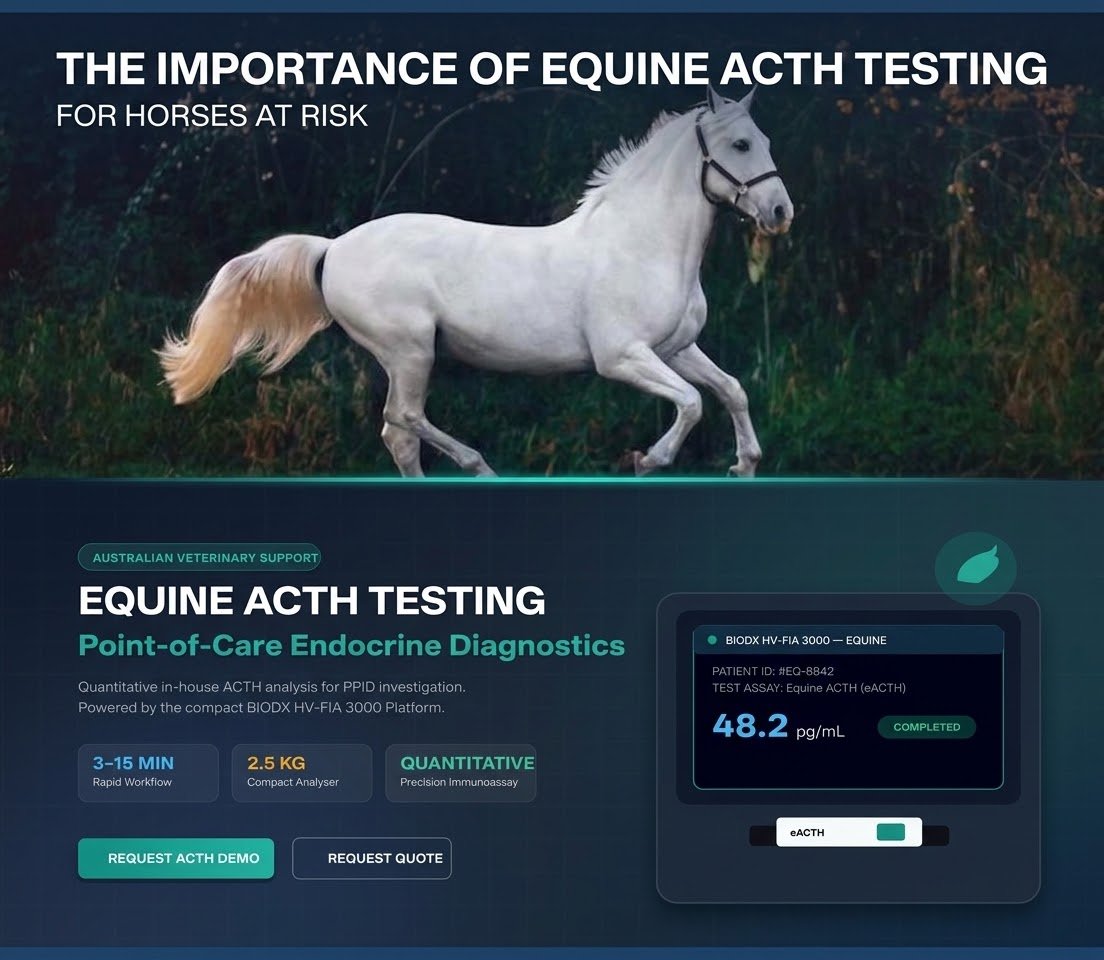
EQUINE ACTH TESTING — BRING ENDOCRINE TESTING CLOSER TO THE HORSE.
Quantitative equine ACTH testing using the BIODX HV-FIA 3000 Veterinary Immunofluorescence Analyser. ACTH testing is an important component of the diagnostic investigation of pituitary pars intermedia dysfunction (PPID) in horses.
WHO IS THIS TEST FOR?
Equine Veterinarians
For practices regularly investigating endocrine disease.
Equine Hospitals
For hospitals managing complex or referral cases.
Mixed Practices
For practices treating both horses and companion animals.
Performance Horse Practices
For veterinarians managing older and performance horses where endocrine assessment forms part of the clinical work-up.
Horse Studs & Breeders
For operations wanting broader access to veterinary diagnostic technology, with ACTH testing performed and interpreted within appropriate veterinary care.
QUICK BENEFITS
01
QUANTITATIVE
Obtain a numerical ACTH result from the assay.
02
POINT OF CARE
Bring selected endocrine testing closer to the patient.
03
COMPACT
The HV-FIA 3000 is a compact 2.5 kg analyser.
04
FAST WORKFLOW
The manufacturer specifies assay-dependent testing times within approximately 3–15 minutes.
WHAT IS INSULIN?
Insulin is a hormone produced by the pancreas that plays a central role in regulating blood glucose and energy metabolism. In horses, abnormal insulin regulation can be clinically important, particularly in animals with metabolic risk factors.
Insulin results should be interpreted together with the horse's history, body condition, diet, clinical findings and the specific testing protocol used. A single insulin result should not be treated as a diagnosis by itself.
WHY TEST INSULIN IN HORSES?
Equine insulin testing can provide objective information when a veterinarian is investigating possible insulin dysregulation or metabolic disease. It may be particularly relevant when a horse has clinical or management features associated with metabolic risk.
• Investigation of suspected insulin dysregulation.
• Support for assessment of horses at risk of equine metabolic syndrome (EMS).
• Assessment of metabolic status in horses with a history or risk of laminitis.
• Investigation of abnormal body condition or regional adiposity in an appropriate clinical context.
• Monitoring selected horses as part of a broader management and veterinary plan.
• Providing quantitative information alongside clinical examination and other diagnostic findings.
INSULIN DYSREGULATION AND LAMINITIS RISK
Insulin dysregulation is clinically relevant in equine metabolic health because abnormal insulin responses are associated with increased risk of endocrinopathic laminitis. Testing can therefore be one component of a broader veterinary assessment of a horse with suspected metabolic risk.
TESTING PROTOCOL MATTERS
Equine insulin results can be influenced by pre-analytical and physiological factors. For that reason, the veterinarian should select and follow an appropriate testing protocol rather than interpreting every insulin result in the same way.
• Document the horse's recent feeding and management.
• Use the sampling protocol appropriate to the clinical question.
• Handle and process the specimen according to the current assay instructions.
• Record relevant clinical and dietary information with the result.
• Interpret against the appropriate laboratory/assay guidance rather than applying an unsupported universal cut-off.
EQUINE METABOLIC SYNDROME — WHERE INSULIN FITS
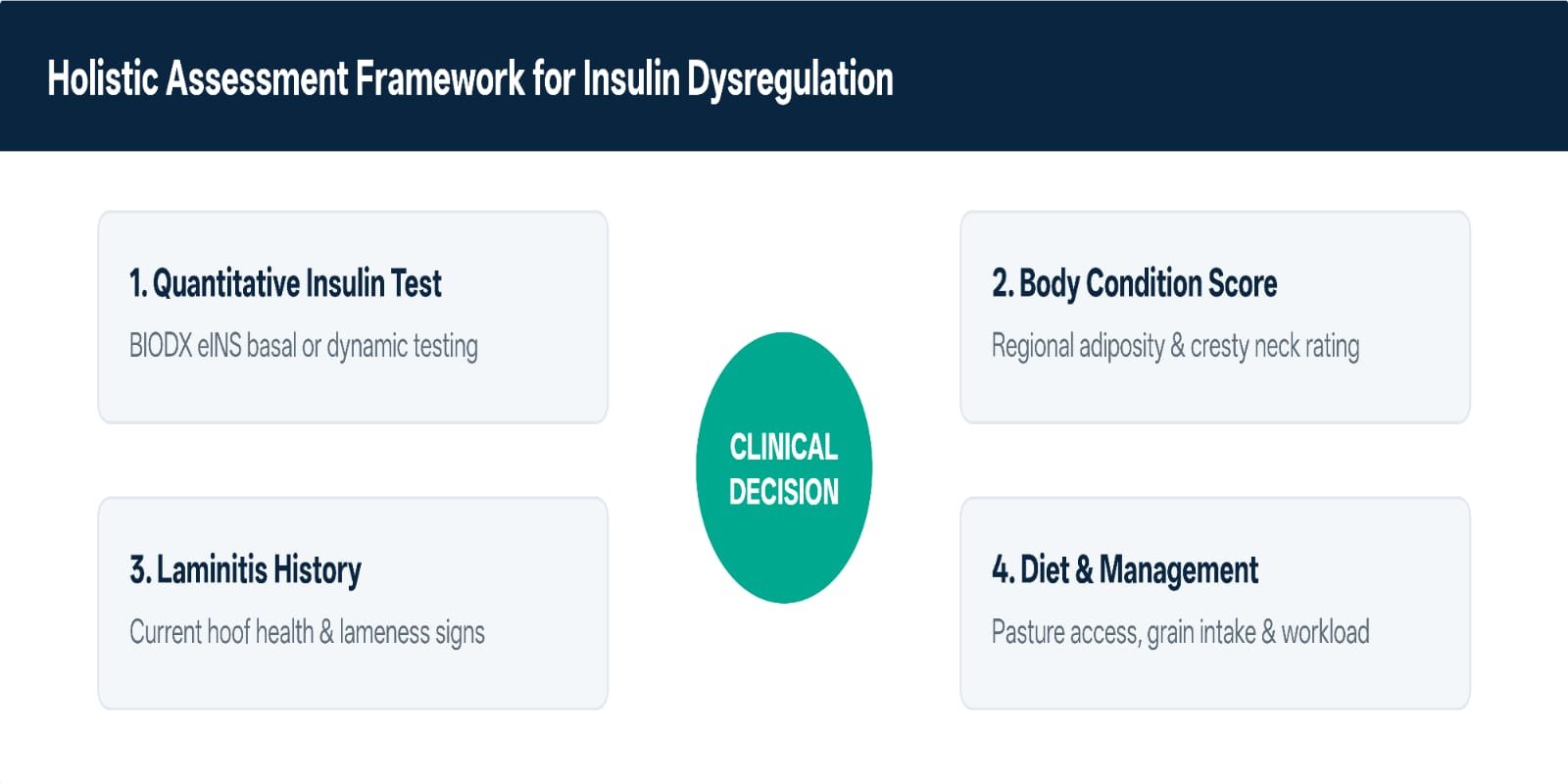
Equine metabolic syndrome is a clinical concept involving metabolic abnormalities and an increased risk of laminitis. Insulin dysregulation is an important component of the assessment, but diagnosis and risk assessment require more than a single insulin measurement.
- Clinical examination and history
- Body condition and regional fat distribution
- Laminitis history and current foot health
- Diet and management review
- Appropriate insulin testing protocol
- Additional testing when clinically indicated
FASTING, BASAL AND DYNAMIC TESTING
Different insulin testing approaches answer different clinical questions. Depending on the case, a veterinarian may use a resting/basal measurement or a controlled dynamic testing protocol. Dynamic testing can be useful when the clinical question is specifically about the horse's insulin response.
The exact protocol, feeding instructions, sampling schedule and interpretation criteria should follow the veterinarian's chosen validated protocol and the current assay/laboratory guidance.
WHY BRING EQUINE INSULIN TESTING IN-HOUSE?
Reduce dependence on sending every metabolic question to an external laboratory, where appropriate.
Support a more responsive workflow when clinical decisions require quantitative information.
Keep testing within the veterinary practice workflow.
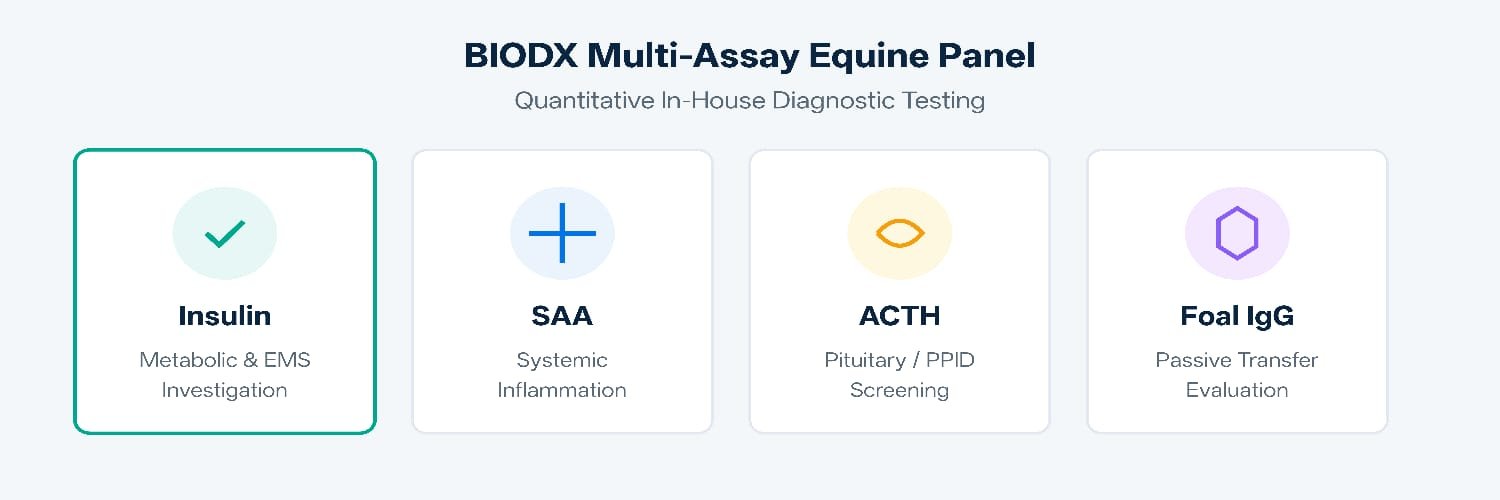
Use the same FIA platform for multiple equine biomarkers rather than purchasing a separate analyser for every test.
Support client communication by linking the quantitative result with the horse's clinical assessment.
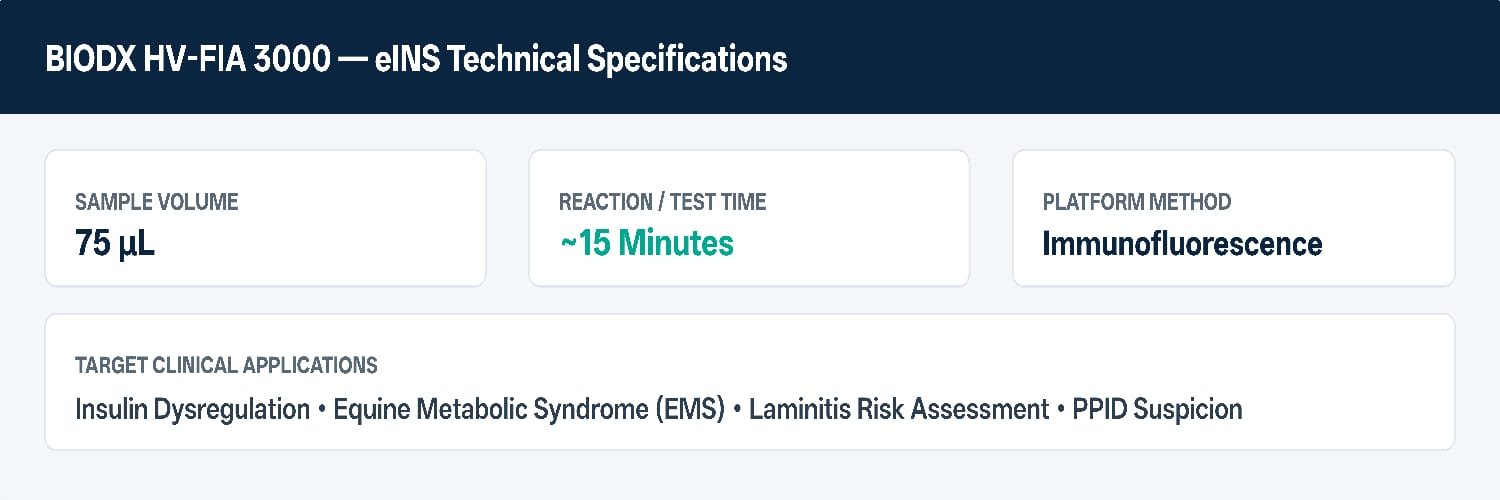
The BIODX HV-FIA 3000 supports quantitative equine insulin testing as part of its equine immunoassay menu.
• Equine insulin (eINS) assay.
• BIODX specification: 75 μL sample volume.
• BIODX specification: approximately 15-minute reaction/test time for eINS.
• Intended clinical application stated by the BIODX: insulin dysregulation, EMS, laminitis risk and PPID suspicion.
• Use the current Australian assay IFU for specimen requirements, preparation, storage, reference information and final reporting requirements.
FROM SAMPLE TO RESULT
ONE ANALYSER. MORE EQUINE QUESTIONS
The HV-FIA 3000 can support a broader equine testing workflow beyond insulin, subject to the current available assay menu.
Technical Specifications
| Test | Equine Insulin (eINS) |
|---|---|
| Platform | BIODX / Healvet HV-FIA 3000 Veterinary Immunofluorescence Analyser |
| Sample volume | 75 μL — manufacturer brochure specification |
| Test/reaction time | Approximately 15 minutes — manufacturer brochure specification |
| Clinical applications stated | Insulin dysregulation, EMS, laminitis risk, PPID suspicion |
| Specimen requirements | Follow current Australian eINS IFU |
| Reference interval / cut-off | Follow current assay-specific and protocol-specific guidance |
| Interpretation | Veterinary clinical interpretation required |
Local Support. Veterinary Focus. Real Diagnostic Capability
YOU BUY THE ANALYSER. BIODX HELPS YOU MAKE IT WORK IN PRACTICE.
Australian Veterinary Supplier
Headquartered in Liverpool, NSW, providing localized customer support and rapid consumable dispatch across Australia.
Application Guidance
Direct assistance selecting test profiles matched to small animal, equine, exotics, or mixed clinical caseloads.
Ongoing Technical Service
Dedicated technical support and account managers to ensure high uptime and long-term diagnostic confidence.
Bring Equine Metabolic Testing Closer to the Horse
Explore quantitative equine insulin testing with the BIODX HV-FIA 3000.