ARTICLE
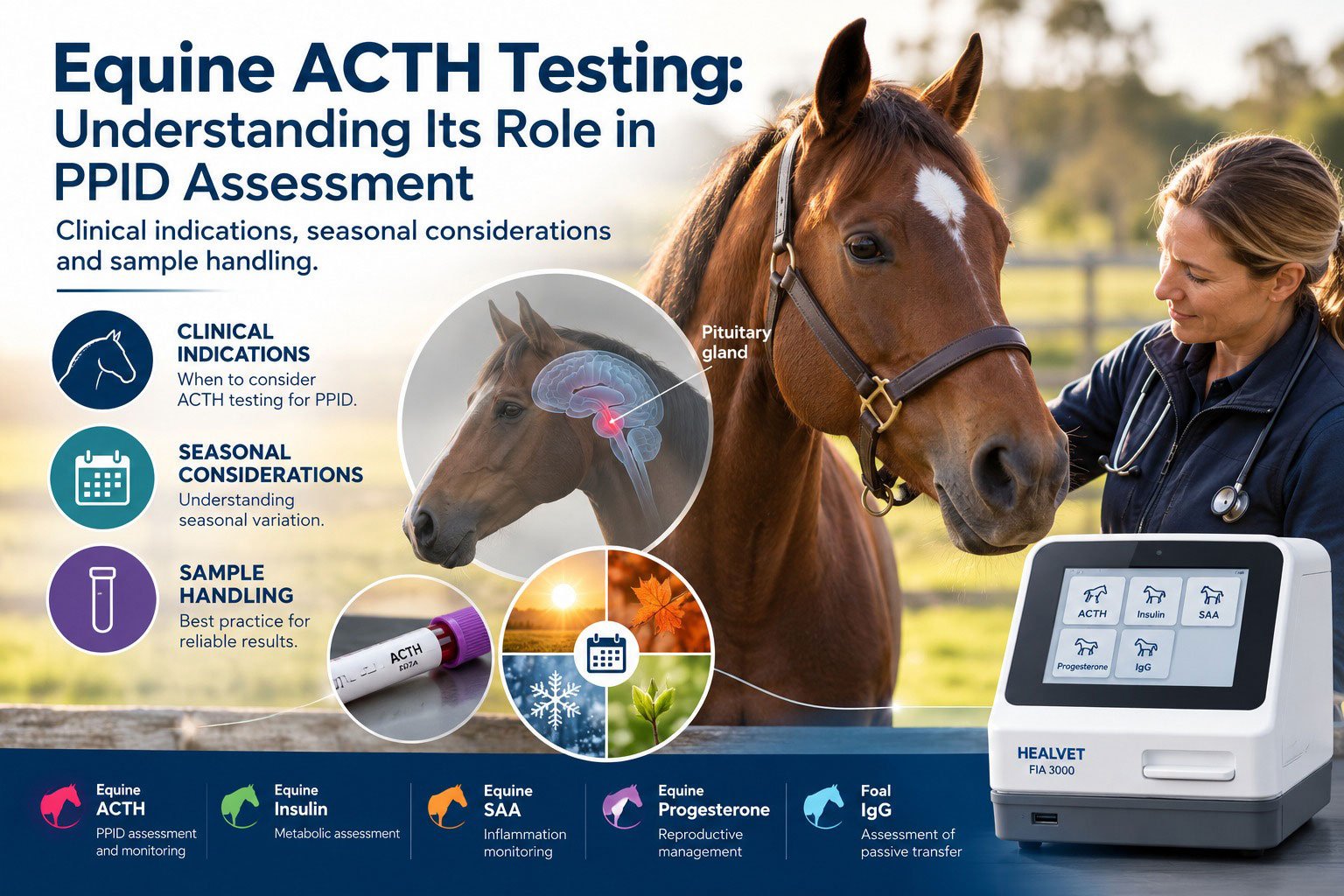
Equine ACTH Testing: Understanding Its Role in PPID Assessment

Pituitary pars intermedia dysfunction (PPID) is an important endocrine disorder in older horses and ponies. Clinical signs can be variable and may develop gradually, making laboratory assessment an important component of diagnosis and monitoring.
Common clinical features that may raise suspicion of PPID include:
· Abnormal or delayed shedding / hypertrichosis
· Muscle loss and weight loss or abnormal fat distribution
· Lethargy or reduced performance
· Polyuria and polydipsia (PU/PD)
· Recurrent infections or delayed wound healing
· Laminitis
Resting endogenous plasma ACTH is a commonly used test when PPID is suspected. It requires a single blood sample and does not require a stimulating or suppressive drug.
ACTH results should not be interpreted in isolation. Clinical signs, season, geographic location, assay methodology and the applicable laboratory-specific reference interval all need to be considered.
In early or mild PPID, resting ACTH may be within a laboratory's reference interval. Where clinical suspicion remains high despite an equivocal resting result, repeat testing or dynamic testing such as a TRH stimulation test may be considered by the veterinarian.
Equine ACTH concentrations show significant seasonal variation. Concentrations generally increase during the shorter-day period of the year. Consequently, interpretation requires season-, geography- and assay-specific reference intervals.
Northern Hemisphere ACTH cut-offs should not simply be transferred to Australian horses without considering the relevant Australian season, population and assay methodology.
Sample Handling
Pre-analytical handling can influence ACTH results. General considerations include:
· Collect blood into an EDTA tube, preferably a plastic tube.
· Chill the sample promptly after collection.
· Separate plasma as practical according to the laboratory or assay instructions.
· If testing is delayed, freeze the sample according to the laboratory/manufacturer's instructions.
· Use appropriate chilled transport where required.
Always follow the current instructions for use (IFU) and the specific laboratory or analyser requirements for collection, processing, storage and transport.
ACTH can be useful both in the assessment of suspected PPID and in ongoing monitoring. For monitoring, consistency is particularly important: ideally use consistent sampling procedures, sample handling, laboratory/analyser, assay methodology, timing and clinical context.
Results from different assays should not automatically be treated as interchangeable. Changes in methodology, laboratory reference intervals or analytical performance can affect interpretation.
Resting ACTH is convenient because it requires a single sample and can be incorporated into routine clinical assessment. Dynamic testing, including TRH stimulation testing, may be considered when early PPID is suspected or when a resting ACTH result is equivocal.
The choice of test should be based on the clinical situation and current veterinary diagnostic guidance.
Point-of-care testing may provide faster access to quantitative ACTH results and can potentially support same-visit clinical decisions while reducing dependence on external laboratory turnaround times.
However, turnaround time alone should not determine whether a point-of-care assay is suitable. Veterinarians should evaluate analytical performance, method comparison or validation data, reference intervals, sample requirements and clinical applicability for the specific assay.
The HEALVET FIA 3000 is a compact veterinary immunofluorescence analyser that includes a range of equine quantitative assays. The equine menu includes:
· Equine ACTH (eACTH)
· Equine Insulin (eINS)
· Equine Serum Amyloid A (eSAA)
· Equine Progesterone (eProg)
· Foal IgG
The manufacturer brochure lists reagent test times of approximately 3–15 minutes, depending on the assay. The equine assays are listed at approximately 5 minutes for eACTH, 15 minutes for eINS, 15 minutes for eProg and 10 minutes for Foal IgG.
Assay | Potential Application | Listed Test Time |
eACTH | PPID assessment and monitoring | Approx. 5 min |
eINS | Insulin dysregulation / metabolic assessment | Approx. 15 min |
eSAA | Inflammation and response-to-treatment monitoring | Assay-dependent |
eProg | Reproductive / estrous cycle monitoring | Approx. 15 min |
Foal IgG | Assessment of passive transfer | Approx. 10 min |
Considering in-house ACTH testing for your equine practice?
Explore how rapid quantitative ACTH testing can fit into your PPID diagnostic and monitoring workflow, alongside Equine Insulin, SAA, Progesterone and Foal IgG.
Request the FIA 3000 Equine Clinical Information Pack or arrange a hands-on demonstration with the BIODX team.
ACTH • Insulin • SAA • Progesterone • Foal IgG
Discuss Equine Point-of-Care Testing with BIODX
Key Takeaways
· Resting ACTH is an important laboratory test when PPID is suspected.
· ACTH results must be interpreted alongside clinical signs and appropriate seasonal, geographic and assay-specific reference intervals.
· Sample collection and handling are important because pre-analytical factors can affect results.
· Early or mild PPID may require repeat or dynamic testing when resting ACTH is equivocal.
· For monitoring, consistency of sampling, handling and assay methodology is important.
· Point-of-care ACTH testing can offer faster access to results, but assay performance and clinical validity should be evaluated alongside turnaround time.
Disclaimer
This article is provided for veterinary educational and informational purposes only. It is not intended to replace professional veterinary judgement, laboratory advice, manufacturer instructions or current diagnostic guidelines. ACTH concentrations must be interpreted in conjunction with the horse's clinical signs, geographic location, season, assay methodology and the applicable laboratory-specific reference intervals. Diagnostic cut-offs may differ between assays and laboratories. Veterinarians should follow the current instructions for use (IFU) and validated reference intervals for the specific assay being used.
References
1. McFarlane D. Diagnosing Equine Pituitary Pars Intermedia Dysfunction in Ambulatory Practice. AAEP Annual Convention 2008. IVIS.
2. McFarlane D. Review of Current Understanding of PPID. AAEP 2013. IVIS.
3. Equine Endocrinology Group. Updated Guidelines for PPID. Equine Veterinary Education, 2018. AAEP proceedings.
4. McFarlane D et al. Pre-analytical considerations and seasonal variation in equine ACTH measurement. Equine Veterinary Education, 2014.
5. AAEP Clinical Pathology: PPID Testing – ACTH (baseline). AAEP Annual Convention Proceedings, 2015.
6. Prutton J, Kass P, Watson P et al. Evaluation of Pre-Analytical Stability of ACTH in Plasma/Whole Blood from Horses. AAEP, 2013.
7. AAEP In-Depth: Laminitis. AAEP Annual Convention Proceedings, 2017.
Our team of diagnostic specialists are here to help. Contact us for personalised guidance and support.