
EQUINE ACTH TESTING — BRING ENDOCRINE TESTING CLOSER TO THE HORSE
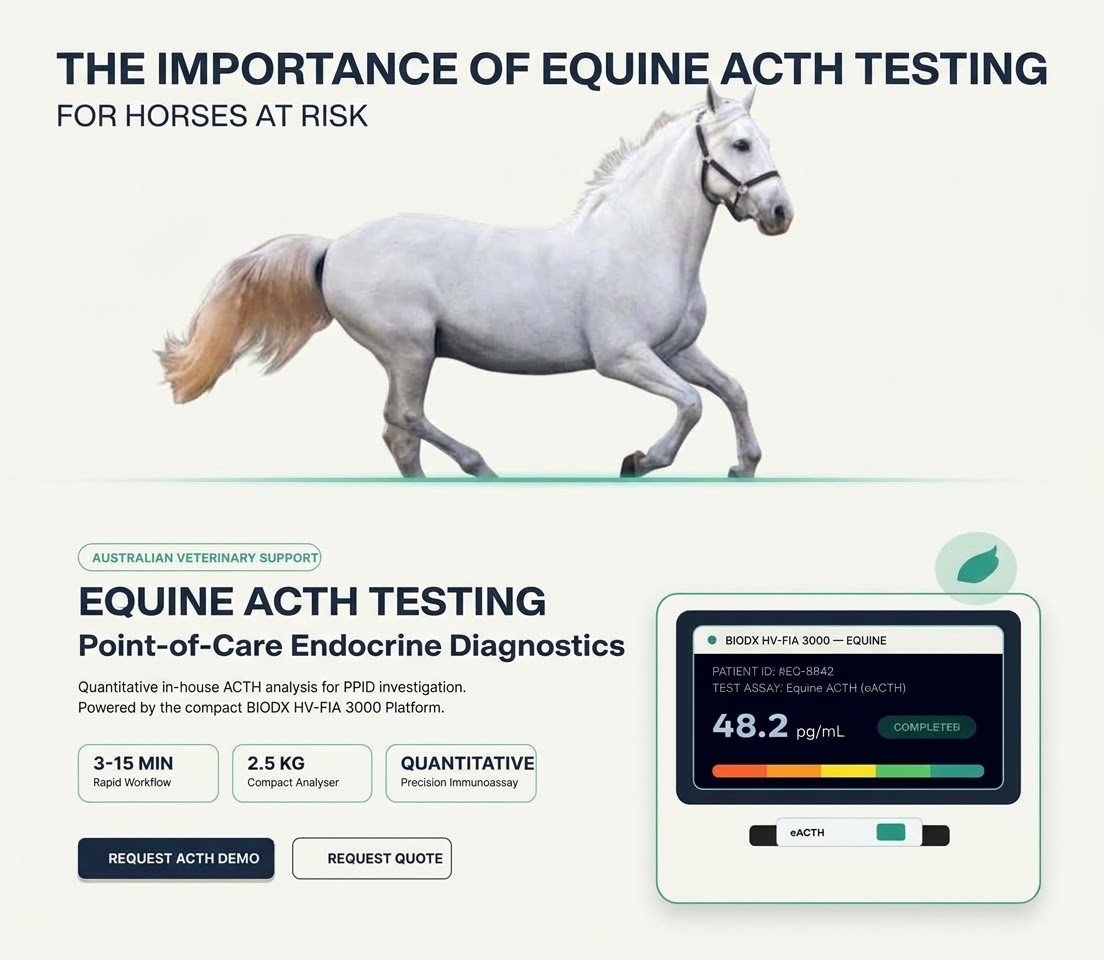
Quantitative equine ACTH testing using the BIODX HV-FIA 3000 Veterinary Immunofluorescence Analyser.
ACTH testing is an important component of the diagnostic investigation of pituitary pars intermedia dysfunction (PPID) in horses.
With the BIODX HV-FIA 3000, veterinary practices can perform the ACTH assay using a compact point-of-care immunofluorescence platform, helping bring relevant endocrine testing into the veterinary workflow.
What is Equine ACTH?
Adrenocorticotropic hormone (ACTH) is a hormone produced by the pituitary gland that plays an important role in regulating adrenal function.
In horses, measurement of endogenous ACTH is commonly used as part of the diagnostic investigation of PPID, particularly in older horses or horses showing compatible clinical signs.
UC Davis notes that a baseline ACTH test can help detect moderate to more advanced PPID, while early disease can be more challenging to detect.
WHY IN-HOUSE ACTH TESTING?
When Might an ACTH Test Be Considered?
How Equine ACTH Testing Works
COLLECT
Collect the appropriate specimen according to the current ACTH assay instructions.
PREPARE
Prepare the sample according to the assay instructions.
TEST
Apply the specified sample volume to the ACTH test cartridge.
ANALYSE
Insert the cartridge into the HV-FIA 3000.
RESULT
The analyser processes the assay and displays the result.
Sample & Testing Information
ACTH Sample Handling Matters
• Appropriate sample type
• Blood collection
• Sample handling
• Processing
• Storage
• Transport
• Timing
ACTH Testing in the PPID Work-Up
• Clinical signs
• Physical examination
• ACTH testing
• Seasonally appropriate reference interval
• Additional endocrine testing where appropriate
• Clinical interpretation
WHO IS THIS TEST FOR?
Equine Veterinarians
For practices regularly investigating endocrine disease.
Equine Hospitals
For hospitals managing complex or referral cases.
Mixed Practices
For practices treating both horses and companion animals.
Performance Horse Practices
For veterinarians managing older and performance horses where endocrine assessment forms part of the clinical work-up.
Horse Studs & Breeders
For operations wanting broader access to veterinary diagnostic technology, with ACTH testing performed and interpreted within appropriate veterinary care.
QUICK BENEFITS
01
QUANTITATIVE
Obtain a numerical ACTH result from the assay.
02
POINT OF CARE
Bring selected endocrine testing closer to the patient.
03
COMPACT
The HV-FIA 3000 is a compact 2.5 kg analyser.
04
FAST WORKFLOW
The manufacturer specifies assay-dependent testing times within approximately 3–15 minutes.
ONE ANALYSER. MORE EQUINE QUESTIONS
TECHNICAL INFORMATION
| Test | Equine ACTH |
|---|---|
| Species | Equine |
| Test principle | Fluorescence immunoassay |
| Platform | HV-FIA 3000 |
| Result | Quantitative |
| Test time | Assay-specific; manufacturer platform range approximately 3–15 minutes |
| Sample | Follow current ACTH IFU |
| Sample volume | Follow current ACTH IFU |
| Storage | Follow current assay instructions |
| Interpretation | Use appropriate reference interval and clinical context |
Frequently Asked Questions
What is an ACTH test used for in horses? +
Does ACTH diagnose PPID? +
Does ACTH change with the seasons? +
Does the horse need to fast? +
How quickly can the FIA 3000 provide an ACTH result? +
Can I also test SAA on the same analyser? +
Can a mixed practice use the FIA 3000? +
Can ACTH testing replace a reference laboratory? +
Ready to implement Equine ACTH?
Talk to our team about adding this test to your in-house diagnostic workflow.